Accra, Ghana - 6 July, 2025 - Ghana’s government has unveiled plans to transform the stalled National Cathedral project in Accra into a National Cultural Convention Centre (NCCC), a move aimed at revitalising the site as a hub for the country’s creative economy and cultural diplomacy.
Announced on 4 July 2025, the initiative, part of the “SH0W24” policy under the 24-hour economy framework, seeks to reposition the controversial site as Africa’s premier venue for international exhibitions, film festivals, trade shows, and summits, in partnership with the African Continental Free Trade Area (AfCFTA) Secretariat.
The decision marks a significant shift from the original vision of a Christian worship centre, which faced years of public backlash over its cost and relevance in a multifaith nation.
The National Cathedral project, launched in March 2017 by then-President Nana Akufo-Addo, was envisioned as a 5,000-seat interdenominational Christian complex to symbolise national unity and gratitude to God, inspired by Akufo-Addo’s 2016 election campaign pledge.
Designed by British-Ghanaian architect Sir David Adjaye, the cathedral was to feature a Bible museum, music school, and art gallery, with a design rooted in Ghanaian cultural symbols like Akan architecture and Ashanti royal stools. However, the project, initially estimated at $100 million, ballooned to $400 million by 2022, with $58 million in public funds spent by mid-2022, despite assurances of private funding. The expenditure, coupled with a lack of transparency, sparked widespread criticism, particularly amid Ghana’s economic challenges, including a 54% inflation rate in December 2022 and a $45 billion national debt.
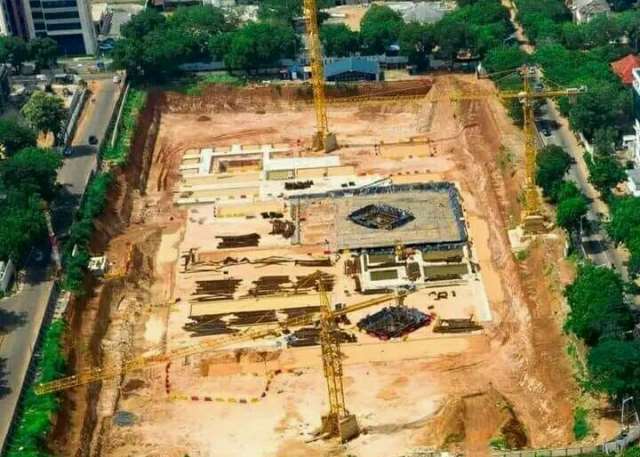
Public outcry intensified as the project stalled, leaving a partially built site described by The New York Times as an “expensive hole” surrounded by aging plywood and inactive cranes. Civil society groups, opposition MPs, and some Muslim leaders questioned the use of taxpayer money in a secular state with pressing needs in healthcare and education. In December 2024, the Commission on Human Rights and Administrative Justice (CHRAJ) recommended a forensic audit and potential prosecution of the project’s board of trustees following allegations of corruption raised by MP Samuel Okudzeto Ablakwa. Newly elected President John Mahama, sworn in on 7 January 2025, announced an investigation into the project’s funding, and by April 2025, his administration dissolved the National Cathedral Secretariat, halting further public funding.
The conversion to the NCCC, detailed in the SH0W24 policy document, aims to address these controversies by repurposing the 14-acre site in central Accra, near Osu Cemetery, into a multipurpose venue. The government, in collaboration with the AfCFTA Secretariat, envisions the NCCC hosting global cultural events to boost Ghana’s creative economy, which contributed 1.5% to GDP in 2023, according to the Ghana Statistical Service.
The policy shift has elicited mixed reactions. Supporters, including Minister of Tourism, Arts and Culture Andrews Egyapa Nsiah, argue that the NCCC will transform Ghana into a cultural powerhouse, creating jobs and boosting tourism, which attracted 1.2 million visitors in 2023.The centre is expected to fill a critical infrastructure gap, offering spaces for exhibitions and summits while avoiding conflicts with Ghana’s multifaith identity. Feasibility studies are set to begin in 2025, with full commissioning targeted for 2028-2030. The SH0W24 initiative also includes plans for a National Creators Academy to train youth in music, film, and digital media, and the construction of over 250 community centres nationwide to operate 24/7 as creative hubs. A digital Ghana Cultural Passport will promote tourism, particularly for the diaspora, while export support systems aim to connect local creatives to global markets.
The SH0W24 initiative also includes financing mechanisms, such as the 24H+ Value Chain Financing Facility, to support creative entrepreneurs. By 2026-2027, regional cultural programmes and creative districts will be launched, with export expansion prioritised by 2030. The government’s pivot reflects a broader effort to leverage Ghana’s rich cultural heritage—evident in its music, film, and fashion industries—to drive economic growth.
Yet, with the cathedral site’s history of controversy, the success of the NCCC will depend on transparent management and public trust, as Ghana seeks to redefine a divisive project into a symbol of inclusive national progress.
Source: Lead News Online