


















Wontumi and Awuku: The Church of Gold and the Charity of Smoke
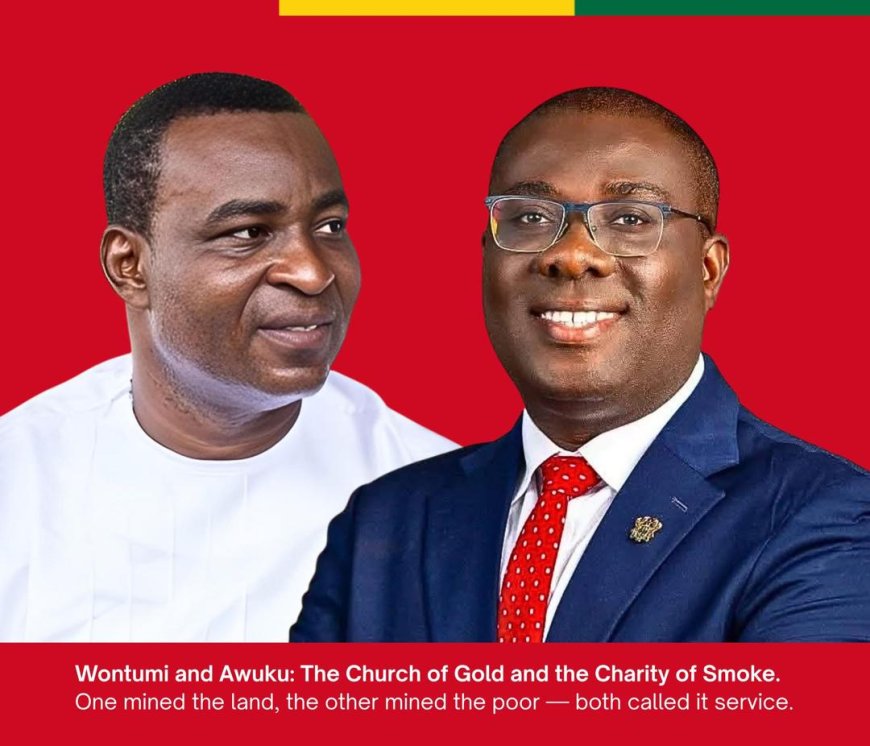


Wontumi once said, “In 2013, Mahama seized my 500 excavators and 400 pickups.” He added, “Mahama won’t be President again, unless he infiltrates the Police, the EC, the Judiciary, and others.” He went further to declare, “Mahama shall never be President again. He is a thing of the past. History. God has sanctioned it.”
A few moments later, the prophetic, immaculate Wontumi, whose bold predictions failed as badly as ECOWAS’s empty threats of war in the Sahel, found himself in the grips of our security agencies twice in recent months. This is the same man who once claimed that even National Security had to “negotiate” with him whenever Mahama visited the Ashanti Region. The same man who said, without hesitation, that the only difference between legal and illegal mining was a document.
Yesterday, October 7, 2025, Bernard Antwi Boasiako, popularly known as Chairman Wontumi, stood before the law he once trivialized. The Accra High Court placed him on an international travel ban, seized his passport, and granted him GH¢15 million bail in a six-count case over mining-related offences. Later that day, he faced another seven-count charge for alleged operations in the Tano Nimiri Forest Reserve and was granted an additional GH¢10 million bail. When he could not meet the combined GH¢25 million, he spent the night in police custody.
His company, Akonta Mining Limited, the golden child of impunity, is accused of assigning mineral rights without approval, facilitating unlicensed mining, and operating within a protected forest reserve. He has pleaded not guilty. But this case carries a message bigger than his name; it is a test of whether Ghana’s justice system can finally apply the law to the powerful with the same firmness it uses on the powerless.
For years, Wontumi embodied the intersection of money, politics, and defiance. He built influence that blurred the lines between mining and illegal mining. For a long time, he was untouchable, a symbol of how political power can protect privilege.
Yet as the media feasts on that spectacle, we must not forget the other face of impunity quietly hiding in plain sight, the National Lottery Authority’s Good Causes Fund under Sammy Awuku. Both stories are mirrors of the same disease. One destroyed rivers; the other drained public compassion. One polluted the land; the other polluted the spirit of governance. In both, the poor paid the price.
The Good Causes Fund was created to support the aged, the needy, and the vulnerable. But under Awuku, millions meant for welfare were spent on publicity, sponsorships, and marketing. One of those sponsorships, the GH¢2 million AstroTurf project, once hailed as a “transformative initiative,” now lies abandoned and unkept. Left to rot. It is not a symbol of progress; it is a monument to hypocrisy.
When Wontumi’s galamsey deepens poverty, you see it: brown rivers, poisoned fish, barren farmlands. When Awuku’s misuse of social funds deepens despair, you don’t see it, but it shows in unpaid hospital bills, delayed community projects, and lost opportunities for those the fund was meant to protect. The results are the same: public suffering, private benefit.
Awuku defends himself with numbers, claiming that 95 percent of the fund went into “transformative projects.” But the law that created the Good Causes Fund did not authorize marketing and false advertising; it authorized compassion. When leaders use the pain of the poor to polish their image for power, they have stolen twice, once from the people’s pockets, and again from their dignity.
Both Wontumi and Awuku reflect a painful truth about power in Ghana: that leadership often serves itself before it serves the people. Both exploited public trust in different ways. If Wontumi’s actions wounded the land, then Awuku’s discounted our national empathy. Both eroded trust and deserve equal accountability.
So as the gavel falls in Accra, Parliament must open its own court of conscience. Let every cedi from the Good Causes Fund be traced. Let every public officer who turned compassion into currency be named. A nation that cannot weigh both crimes equally will keep sinking, one scandal, one silence at a time.
Let Ghana learn again that no man can mine integrity out of gold, and no office can house irony without consequence.
Because if these events do not recalibrate our moral compass, then the next scandal will simply wear a different name, and we will still clap.
Credit - Kay Codjoe
What's Your Reaction?